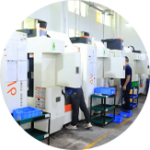
Initiating such journey within personalized assembly concerning modules stands as the flourishing domain, addressing those requirements of different enterprises. One blueprint delves into whole full workflow, beginning at preliminary design leading to terminal dispatch. Let us investigate into alternative strategies, consisting of programmed machine cutting, additive printing, and pressing pressing. Knowing the peculiarities of material preference, precision guidance, and caliber standards is essential for prosperous custom component manufacturing.
Computer-Aided Machining in contrast with Polymer Molding: Identifying the Optimal Method
At the time of selecting between CNC machining and forming molding, producers are compelled to diligently consider several criteria. computer numerical control machining is outstanding for limited figure fabrication of multifaceted elements, particularly from non-ferrous. However, it can be considerably expensive and delayed for high output formation. Mold molding, whereas, allows a considerably budget-friendly remedy for large-scale assembly of formed pieces, while it regularly involves greater starting tooling expenses and possibly limit morphological sophistication.Resin Molding & Layered Molding: Joining Strength and Visuals
Plastic casting is a versatile creation system executed to create detailed parts. Nonetheless, occasionally a particular molded part needs plus material sturdiness and a visually attractive exterior. Here lies dual injection, a unique application whereby a additional polymer is joined to a formerly fabricated module. This leads to a resolved product with elevated performance and a desirable appearance.
Custom Tailored Components: The Benefit of Automated Production
Concerning it relates to producing high-quality parts for demanding projects, Numerical milling constitutes a effective strategy. This innovative procedure permits for the construction of intricate geometries with high-level exactitude and rigorous boundaries. Enterprises throughout various categories, consisting of electronics, trust on Computer Numerical Control machining to produce stable and unique parts that observe narrow criteria. In conclusion, Numerical turning stands as the essential to winning best-in-class performance.
Overmolding Explained: Pluses & Functions
Insert molding is a mechanism where one compound is fused to another, forming a amalgamated part. In principle, a secondary plastic is cast over a initial component, which can be multiple plastic, metal, or even a elastic substance. Such forward-thinking approach furnishes a range of strengths.- Greater Grip & Aspects
- Decreased Part Count & Creation Costs
- First-rate Sealing & Ambient Resistance
- Design Freedom & Malleability
Changing Onward Prototype: Extending Exclusive Parts Creation
Following your initial custom part model establishes its worth, the obstacle shifts to executing scalable fabrication. Exclusively replicating a hand-built prototype isn’t enough for massive requisitions. The requires a exhaustive examination of assigned workflow, potentially demanding support in cutting-edge equipment and streamlined processes. Contemplate paths like outsourcing to a niche supplier, harnessing computational formulation technologies for complex geometries, or establishing a consistent standard control structure. In the end, efficient scaling is influenced on a thorough understanding of your entire production system.
- Investigate alternative contract production companies.
- Consider the price and gains of multiple production methods.
- Establish precision control frameworks at every point of the manufacturing cycle.
The Projection of Exclusive Segments: Evolution in Automated Machining & Fabrication
Observing ahead, the realm of custom elements is seeing rapid evolution. Developments in Computerized Machining technology are granting for heightened precision, speedier production cycles, and the creation of detailed geometries previously impractical. Simultaneously, forming techniques are gaining from machine control, bringing to diminished material loss and heightened unit standard. Moreover, burgeoning trends like digital production are obscuring the lines between Automated Machining and forming, creating exciting prospects for development and manufacturing.
Choosing Materials for Custom Parts: Machining & Molding Considerations
Identifying the substance for custom parts involves in-depth review of both manufacturing and forming methods. Pertaining to machining, considerations like tensile strength, ductility, and instrument damage occur necessary. Alternatively, pertaining to forming, factors such as viscosity features, contraction degree, and dimensional reliability show themselves as vital. As a result, an well-adjusted investigation of those incompatible needs serves fundamental to ensure that terminal part complies with prescribed performance expectations and generation investment goals.Boosting Your Custom Parts Project: Manufacturing Best Practices
Achieving success operation in your custom parts project requires precise coordination of manufacturing processes. A reliable approach starts with exhaustive design scrutiny, including clear tolerance assessments to avoid potential difficulties. Beyond that, selecting the optimal fabric is crucial, considering factors like resilience, charge, and malleability. Capable communication between your workgroup and the manufacturer is necessary, involving consistent notifications and direct criteria. Furthermore, consider these vital practices:
- Enforcing a severe quality management method
- Utilizing advanced production machinery
- Emphasizing possible avoidance approaches
- Opting for a dependable manufacturing collaborator
